
How these dates were made
Why this bar's edges are floors, not a founding and a fall.
The atlas draws the world at 3 moments in time, not continuously. This bar runs from the first snapshot in which Islamic and Hindu states appears to the last, so both edges are floors — the earliest and latest years it is attested, not a founding and a dissolution.
Elsewhere in South Asia at the time
Records whose own span overlaps this one, found by the same test the canvas draws with. The bar under each card is where it sits inside this one.
.jpeg/500px-Taj_Mahal_(Edited).jpeg)
Landmark · South Asia
Taj Mahal
1632 CE – still standing
Polity · South Asia
Ceylon
Attested 1650 CE – 1938 CE
Conflict · South Asia
Mughal-Rajput Wars
1557 CE – 1707 CE_(cropped).jpg/500px-Wide_angle_of_Galigopuram_of_Virupaksha_Temple%2C_Hampi_(04)_(cropped).jpg)
Landmark · South Asia
Hampi
1336 CE – 1565 CE
Polity · South Asia
Orissa
Attested 1000 CE – 1600 CEConflict · South Asia
Mughal–Deccan Wars
1595 CE – 1707 CE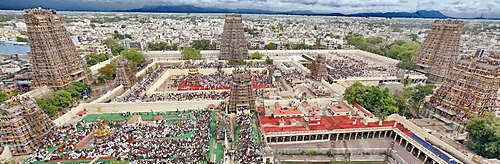
Landmark · South Asia
Meenakshi Temple
1600 CE – still standing
Polity · South Asia
Kandy
Attested 1650 CE – 1800 CEDated moments inside this span
Events the timeline places between 1530 CE and 1650 CE.
And in the rest of the world
Records running through the same years, on the other side of the map.
Image credits7 pictures from Wikimedia Commons
- Taj MahalYann; edited by Jim Carter · CC BY-SA 4.0
- Flag of Sri LankaOriginal: Sri Lanka Vectorization: Zscout370, Mike Rohsopht · Public domain
- Mughal–Rajput wars"Mirza 'Abd al-Rahim, Khan-i khanan (Mirza 'Abd al-Rahim, Khan-i khanan)" · Public domain
- HampiiMahesh · CC BY-SA 4.0
- OdishaUdayakuni · CC BY-SA 3.0
- Meenakshi Templeஎஸ்ஸார் · CC BY 3.0
- KandyA.Savin · FAL
.jpeg)


_(cropped).jpg)


