
Djenné-Djenno
250 BCE – 1400 CE · 1,650 years
One of the oldest known cities in sub-Saharan Africa, a major trading center on the Niger River in Mali
Wikipedia
The opening of the article, and a way into the rest of it without leaving the site.
Djenné-Djenno on Wikipedia.
From Wikipedia, available under CC BY-SA 4.0.
Who held this ground
Borders from dated snapshots, up to a century apart; precision varies.
Reconstruction
- Before it was built (3000 BCE–300 BCE)
- Saharan Pastoral Nomads (200 BCE) Border precision: Approximate
- No border recorded here in this snapshot (100 BCE–600 CE)
- Saharan Nomadic Tribes (700 CE) Border precision: Approximate
- No border recorded here in this snapshot (800 CE)
- Berbers (900 CE) Border precision: Approximate
- No border recorded here in this snapshot (1000 CE–1100 CE)
- Berber Tribes (1200 CE) Border precision: Approximate
- Mali (1279 CE–1400 CE) Border precision: Approximate
- Songhai (1492 CE–1600 CE) Border precision: Approximate
- No border recorded here in this snapshot (1650 CE–1700 CE)
- Segu (1715 CE–1800 CE) Border precision: Defined
- No border recorded here in this snapshot (1815 CE)
- Tukulor Caliphate (1880 CE) Border precision: Defined
- French West Africa (1900 CE–1938 CE) Border precision: Defined
- French Sudan (1945 CE) Border precision: Defined
- Mali (1960 CE–2026 CE) Border precision: Defined
- Defined
- Approximate
Elsewhere in Africa at the time
Records whose own span overlaps this one, found by the same test the canvas draws with. The bar under each card is where it sits inside this one.

Landmark · Africa
Volubilis
300 BCE – 1200 CE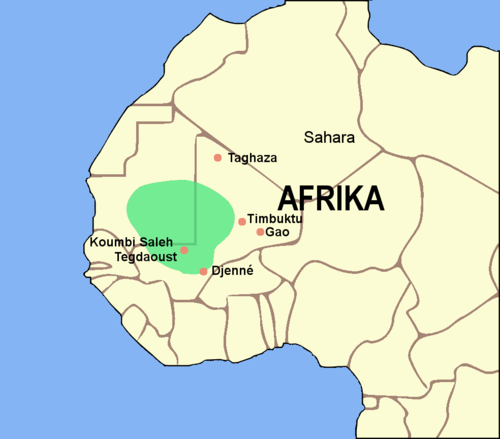
Polity · Africa
Empire of Ghana
100 CE – 1200 CETrade route · Africa
Trans-Saharan Western Route
400 CEConflict · Africa
Kanem–Bornu Wars
700 CE – 1846 CE
Landmark · Africa
Osun-Osogbo Sacred Grove
200 BCE – still standing
Polity · Africa
Morocco
Founded 789 CE · attested to 2026 CETrade route · Africa
Trans-Saharan Eastern Route
400 CEConflict · Africa
Ghana–Almoravid Conflict
1054 CE – 1083 CEDated moments inside this span
Events the timeline places between 250 BCE and 1400 CE.
And in the rest of the world
Records running through the same years, on the other side of the map.
Image credits 4 pictures from Wikimedia Commons
- Volubilis Subhros · CC BY-SA 3.0
- Ghana Empire Luxo · CC BY-SA 3.0
- Osun-Osogbo ABORISADEADETONA · CC BY-SA 4.0
- Flag of Morocco Denelson83, Zscout370 · Public domain


