
The Middle Ages, 500–1500 CE
1,000 years · 2,410 records · 297 dated moments
A thousand years, and the busiest stretch of the canvas.
Successor kingdoms, caliphates, steppe empires, the Mali and Songhai of West Africa, Song and Ming China, the Khmer and Srivijaya. This is the widest part of the atlas, so it is the densest part of the timeline: lanes stack two rows deep and the quota per record kind is doing real work to keep landmarks and figures visible between the empires.
The states the atlas drew most often
The polities the canvas draws first in this age, when it has room for only a few.

South Asia
Tibet
Attested 1000 CE – 1960 CE.svg/500px-Flag_of_the_Ottoman_Empire_(1844%E2%80%931922).svg.png)
Europe
Ottoman Empire
1299 CE – 1922 CE.svg/500px-Banner_of_the_Holy_Roman_Emperor_with_haloes_(1430-1806).svg.png)
Europe
Holy Roman Empire
962 CE – 1806 CESouth Asia
Hindu kingdoms
Attested 500 BCE – 1715 CE
Middle East
Egypt
Attested 3000 BCE – 2026 CE
Europe
Sweden
Founded 900 CE · attested to 2026 CE
South Asia
Simhala
Attested 500 BCE – 700 CE.svg/500px-Flag_of_Iran_(official).svg.png)
Middle East
Persia
Attested 400 CE – 1914 CEBest-evidenced conflicts
Ranked the way the war lane ranks them: the ones the canvas draws first.
East Asia
Sengoku Period (Japanese Warring States)
1467 CE – 1615 CENearly 150 years of civil war as feudal warlords fought for supremacy across Japan. Three great unifiers — Oda Nobunaga, Toyotomi Hideyoshi, and Tokugawa Ieyasu — progressively reunified the country, culminating in the Tokugawa Shogunate that would rule for 250 years.
East Asia
Goguryeo–Sui Wars
598 CE – 614 CEThe Sui Dynasty launched four massive invasions of the Korean kingdom of Goguryeo, mobilising over a million troops. The catastrophic defeats — especially the annihilation of 300,000 soldiers at the Salsu River — triggered rebellions that toppled the Sui Dynasty itself.
Europe
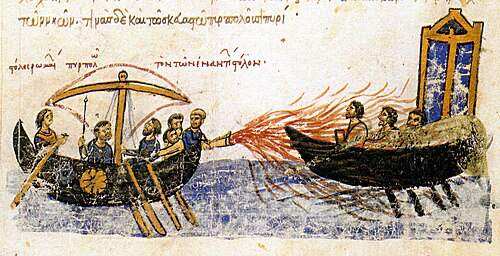
Byzantine–Arab Wars
629 CE – 1180 CECenturies of warfare between Byzantium and successive Arab caliphates. The Arabs besieged Constantinople twice (674–678, 717–718) but failed both times, with Greek fire proving decisive. The frontier stabilized along the Taurus Mountains for centuries.

East Asia
An Lushan Rebellion
755 CE – 763 CEA devastating civil war within the Tang Dynasty that killed an estimated 13–36 million people — possibly one-sixth of the world's population — permanently weakening China's greatest medieval dynasty.

Europe
Viking Invasions
793 CE – 1066 CENearly three centuries of Norse raids, conquests, and settlements that reshaped northern Europe — from the sack of Lindisfarne to the Norman conquest of England.
Europe
Wars of the Kievan Rus'
860 CE – 1240 CEThe Rus' state expanded from Viking origins into a major European power, warring with Byzantium and steppe nomads before fracturing into rival principalities conquered by the Mongols.

Middle East
The Crusades
1096 CE – 1291 CETwo centuries of religious warfare for control of the Holy Land — nine major crusades that transformed trade, culture, and the balance of power between Christendom and Islam.

Europe
The Anarchy
1135 CE – 1153 CEA civil war over the English throne between Stephen and Matilda, Henry I's daughter. England descended into chaos as rival barons built unlicensed castles and ravaged the countryside. It ended with the Treaty of Wallingford, securing the throne for Matilda's son Henry II.
Still standing, and who was alive
Landmarks standing during this age, and people who lived in it.
.jpeg/500px-Canyon_River_Tree_(165872763).jpeg)
Landmark · Americas
Grand Canyon
3000 BCE – still standingImmense gorge carved by the Colorado River over millions of years

Landmark · Oceania
Great Barrier Reef
3000 BCE – still standingWorld's largest coral reef system, visible from space

Landmark · Europe
Plitvice Lakes
3000 BCE – still standingCascading chain of sixteen turquoise lakes connected by waterfalls in the Croatian highlands

Landmark · Europe
Giant's Causeway
3000 BCE – still standing40,000 interlocking basalt columns formed by ancient volcanic eruptions on the Northern Irish coast

Figure · Arabian Peninsula
Muhammad
570 CE – 632 CEFrom an orphaned merchant in Mecca to the founder of a civilization — the life of Muhammad ibn Abdullah, told in his own words: the first revelation, the Hijra, the battles of Badr and Uhud, the conquest of Mecca, and the Farewell Sermon that completed a faith for 1.8 billion people.

Figure · Frankish Empire
Charlemagne
742 CE – 814 CEThe Frankish king who conquered half of Europe, was crowned Emperor of the Romans on Christmas Day 800, and launched a cultural renaissance that preserved learning through the Dark Ages — the man historians call the Father of Europe.
.jpg/500px-Madrid_-_Ciudad_Universitaria%2C_Monumento_a_Muhammad_al-Juarismi_(cropped).jpg)
Figure · Baghdad
Al-Khwarizmi
780 CE – 850 CEThe Baghdad scholar who gave the world algebra and the word algorithm — how a ninth-century polymath at the House of Wisdom synthesised Greek, Indian, and Persian mathematics into a system that would power every equation ever written.
Figure · India (Kerala to the Himalayas)
Shankara
788 CE – 820 CEIn thirty-two years, Adi Shankaracharya walked the length of India barefoot, defeated every rival philosophical school in open debate, founded four monasteries that still stand today, and delivered one message that reshaped a civilization: you are Brahman. You always were.
Dated moments
16 of 297, spread evenly across the age.
Image credits19 pictures from Wikimedia Commons
- TibetUniversity of Texas Libraries · CC BY-SA 3.0
- Flag of the Ottoman Empire (1844–1922)User:Orwellianist · Public domain
- Banner of the Holy Roman Emperor with haloes (1430-1806)David Liuzzo, eagle by N3MO · CC BY-SA 3.0
- Flag of EgyptDerived from Part IV Article (223) of the Constitution of The Arab Republic of Egypt. Col… · Public domain
- Flag of SwedenJon Harald Søby and others. · Public domain
- Sinhalese peopleDodopoo · CC BY-SA 4.0
- Flag of Iran (official)SVG file: SiBr 4 Designer: Hamid Nadimi Construction: ISIRI · Public domain
- Arab–Byzantine warsCodex Skylitzes Matritensis, Bibliteca Nacional de Madrid, Vitr. 26-2, Bild-Nr. 77, f 34 … · Public domain
- An Lushan rebellionSY · CC BY-SA 4.0
- Viking expansionAbbey of Saint-Aubin · Public domain
- Crusadesanonymus · Public domain
- The AnarchyThe British Library Catalogue of Illuminated Manuscripts · Public domain
- Grand CanyonLennart Sikkema · CC BY 3.0
- Great Barrier ReefNASA/Kjell Lindgren · Public domain
- Plitvice Lakes National ParkZysko serhii · CC BY-SA 4.0
- Giant's Causewaycode poet on flickr. · CC BY-SA 2.0
- Muhammadبلال الدويك · CC BY-SA 3.0
- CharlemagneCharlemagne. Autoritémettrice de monnaie indéterminé. Atelier monétaire. Émetteur · Public domain
- Al-KhwarizmiZarateman · CC0

.svg)
.svg)


.svg)


.jpeg)


.jpg)