

Wikipedia
The opening of the article, and a way into the rest of it without leaving the site.
Saxony on Wikipedia.
From Wikipedia, available under CC BY-SA 4.0.
How these dates were made
Why this bar's edges are floors, not a founding and a fall.
The atlas draws the world at 3 moments in time, not continuously. This bar runs from the first snapshot in which Saxony appears to the last, so both edges are floors — the earliest and latest years it is attested, not a founding and a dissolution.
Elsewhere in Europe at the time
Records whose own span overlaps this one, found by the same test the canvas draws with. The bar under each card is where it sits inside this one.

Landmark · Europe
Butrint
800 BCE – 1800 CE.svg/500px-Banner_of_the_Holy_Roman_Emperor_with_haloes_(1430-1806).svg.png)
Polity · Europe
Holy Roman Empire
962 CE – 1806 CE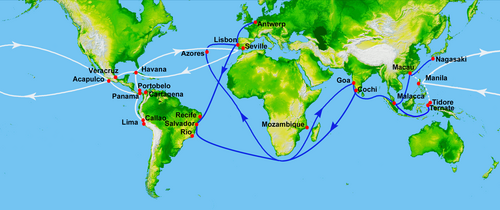
Trade route · Europe
Spanish Treasure Fleet
1566 CE – 1790 CE.jpg/500px-Napoleonic_Wars_(revision).jpg)
Conflict · Europe
Napoleonic Wars
1803 CE – 1815 CELandmark · Europe
Ragusa (Dubrovnik)
700 CE – 1808 CE
Polity · Europe
Denmark-Norway
Attested 1000 CE – 1800 CETrade route · Europe
Dutch East India Route
1602 CE – 1799 CE
Conflict · Europe
French Revolutionary Wars
1792 CE – 1802 CEDated moments inside this span
Events the timeline places between 1783 CE and 1815 CE.
And in the rest of the world
Records running through the same years, on the other side of the map.
Image credits7 pictures from Wikimedia Commons
- Flag of SaxonyMadden · Public domain
- ButrintGeoff Wong · CC BY 2.0
- Banner of the Holy Roman Emperor with haloes (1430-1806)David Liuzzo, eagle by N3MO · CC BY-SA 3.0
- Spanish treasure fleetWorld_Topography.jpg : NASA/JPL/NIMA derivative work: Uxbona ( talk ) · Public domain
- Napoleonic WarsRuedi33a · CC BY-SA 4.0
- Flag of DenmarkMadden and others · Public domain
- French Revolutionary WarsRuedi33a · CC BY-SA 4.0


.svg)

.jpg)

