

Mogao Caves
366 CE – still standing
UNESCO complex of 492 Buddhist cave temples near Dunhuang containing a thousand years of murals and sculptures along the ancient Silk Road
Wikipedia
The opening of the article, and a way into the rest of it without leaving the site.
Mogao Caves on Wikipedia.
From Wikipedia, available under CC BY-SA 4.0.
Who held this ground
Borders from dated snapshots, up to a century apart; precision varies.
Reconstruction
- Before it was built (3000 BCE–300 CE)
- Northern Liang (400 CE) Border precision: Approximate
- No border recorded here in this snapshot (500 CE–600 CE)
- Karluks (700 CE) Border precision: Approximate
- Tibetan Empire (800 CE) Border precision: Approximate
- Tibet (900 CE) Border precision: Approximate
- Xixia (1000 CE–1200 CE) Border precision: Approximate
- Great Khanate (1279 CE–1300 CE) Border precision: Approximate
- Ming Empire (1400 CE) Border precision: Approximate
- Chagatai Khanate (1492 CE–1500 CE) Border precision: Approximate
- No border recorded here in this snapshot (1530 CE)
- central Asian khanates (1600 CE–1715 CE) Border precision: Approximate
- Qing Empire (1783 CE–1800 CE) Border precision: Not stated
- Manchu Empire (1815 CE–1900 CE) Border precision: Defined
- Republic of China (1914 CE) Border precision: Defined
- Chinese Warlords (1920 CE–1930 CE) Border precision: Defined
- Republic of China (1938 CE) Border precision: Defined
- China (1945 CE–2026 CE) Border precision: Defined
- Defined
- Approximate
- Not stated
Running at the same time
Records whose own span overlaps this one, found by the same test the canvas draws with. The bar under each card is where it sits inside this one.

Landmark
Mausoleum of Khoja Ahmed Yasawi
1389 CE – still standingPolity
central Asian khanates
Attested 1530 CE – 1900 CETrade route
Silk Road Southern Branch
200 BCE – 1450 CE
Figure · Arabian Peninsula
Muhammad
570 CE – 632 CE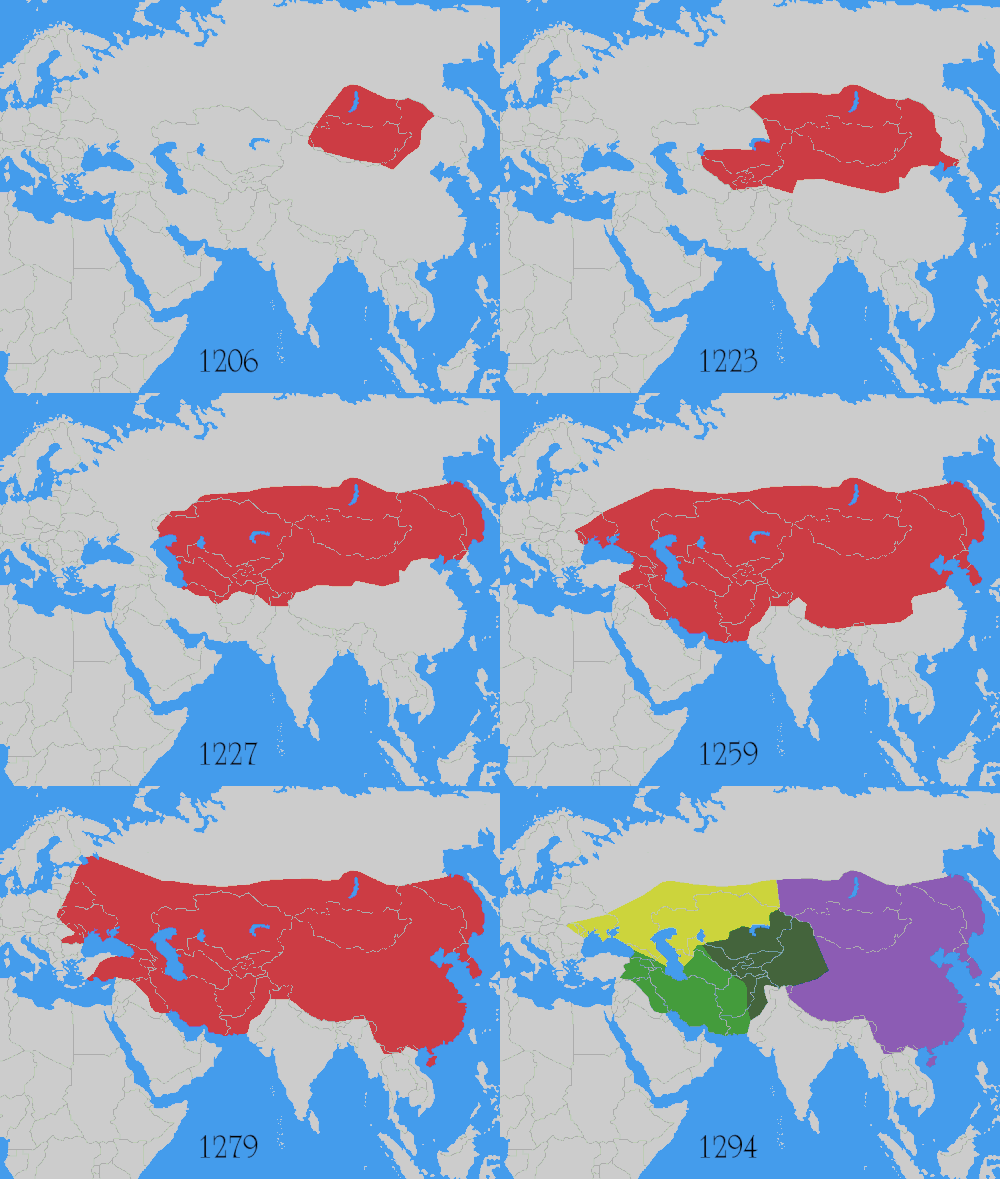
Conflict
Mongol Conquests
1206 CE – 1368 CELandmark
Afrasiab (Ancient Samarkand)
500 BCE – 1220 CE
Polity
Srivijaya Empire
650 CE – 1400 CETrade route
Manila Galleon Return Route
1565 CE – 1815 CEDated moments inside this span
Events the timeline places between 366 CE and 2026 CE.
And in the rest of the world
Records running through the same years, on the other side of the map.
Image credits 5 pictures from Wikimedia Commons
- Mogao Caves xiquinhosilva · CC BY 2.0
- Mausoleum of Khoja Ahmed Yasawi Petar Milošević · CC BY-SA 3.0
- Muhammad بلال الدويك · CC BY-SA 3.0
- Mongol conquests User:Astrokey44 · CC BY-SA 3.0
- Srivijaya Empire Gunawan Kartapranata · CC BY-SA 3.0


