
_in_einem_Halbkreis_endend_Le_M%C3%A9nec%2C_Carnac%2C_Departement_Morbihan%2C_Bretagne_Steffen_Heilfort.jpg/960px-4748.1099_Menhire%2C_bis_zu_4_Meter_hoch%2C_von_OstnachWest_in_1167_Meter_Langen_Alignements_(Granit-Steinreihen)_in_einem_Halbkreis_endend_Le_M%C3%A9nec%2C_Carnac%2C_Departement_Morbihan%2C_Bretagne_Steffen_Heilfort.jpg)
Landmark Europe archaeological
Carnac Stones
3300 BCE – still standing
Thousands of prehistoric standing stones in Brittany, France
Wikipedia
The opening of the article, and a way into the rest of it without leaving the site.
Carnac stones on Wikipedia.
From Wikipedia, available under CC BY-SA 4.0.
Elsewhere in Europe at the time
Records whose own span overlaps this one, found by the same test the canvas draws with. The bar under each card is where it sits inside this one.

Landmark · Europe
Plitvice Lakes
3000 BCE – still standing.svg/500px-Flag_of_the_Ottoman_Empire_(1844%E2%80%931922).svg.png)
Polity · Europe
Ottoman Empire
1299 CE – 1922 CE
Conflict · Europe
World War I
1914 CE – 1918 CE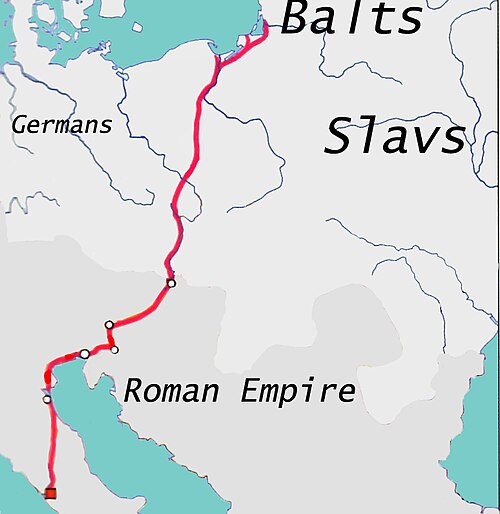
Trade route · Europe
Amber Road
1000 BCE – 400 CE
Landmark · Europe
Giant's Causeway
3000 BCE – still standing.svg/500px-Banner_of_the_Holy_Roman_Emperor_with_haloes_(1430-1806).svg.png)
Polity · Europe
Holy Roman Empire
962 CE – 1806 CE
Conflict · Europe
World War II
1939 CE – 1945 CETrade route · Europe
Roman Mediterranean Trade
27 BCE – 476 CEDated moments inside this span
Events the timeline places between 3300 BCE and 2026 CE.
And in the rest of the world
Records running through the same years, on the other side of the map.
Image credits8 pictures from Wikimedia Commons
- Carnac stonesSteffen Heilfort · CC BY-SA 3.0
- Plitvice Lakes National ParkZysko serhii · CC BY-SA 4.0
- Flag of the Ottoman Empire (1844–1922)User:Orwellianist · Public domain
- World War ICollection DocAnciens/docpix.fr · Public domain
- Amber RoadBearas · CC BY-SA 3.0
- Giant's Causewaycode poet on flickr. · CC BY-SA 2.0
- Banner of the Holy Roman Emperor with haloes (1430-1806)David Liuzzo, eagle by N3MO · CC BY-SA 3.0
- World War IIRichard Opitz · CC BY-SA 3.0 de
_in_einem_Halbkreis_endend_Le_M%C3%A9nec%2C_Carnac%2C_Departement_Morbihan%2C_Bretagne_Steffen_Heilfort.jpg)

.svg)


.svg)
