

Newark Earthworks
100 BCE – 400 CE · 500 years
Largest earthen enclosures in the world, built by the Hopewell culture in Ohio, including a giant octagon aligned to track the moon's 18.6-year cycle.
Wikipedia
The opening of the article, and a way into the rest of it without leaving the site.
Newark Earthworks on Wikipedia.
From Wikipedia, available under CC BY-SA 4.0.
Who held this ground
Borders from dated snapshots, up to a century apart; precision varies.
Reconstruction
- Before it was built (3000 BCE–200 BCE)
- Hopewell Culture (100 BCE–500 CE) Border precision: Approximate
- Eastern North American hunter-gatherers (600 CE–1400 CE) Border precision: Approximate
- Kaskaskia (1492 CE) Border precision: Approximate
- No border recorded here in this snapshot (1500 CE–1715 CE)
- United States of America (1783 CE–1800 CE) Border precision: Defined
- United States (1815 CE) Border precision: Defined
- United States of America (1880 CE–1900 CE) Border precision: Defined
- United States (1914 CE–2026 CE) Border precision: Defined
- Defined
- Approximate
Elsewhere in Americas at the time
Records whose own span overlaps this one, found by the same test the canvas draws with. The bar under each card is where it sits inside this one.
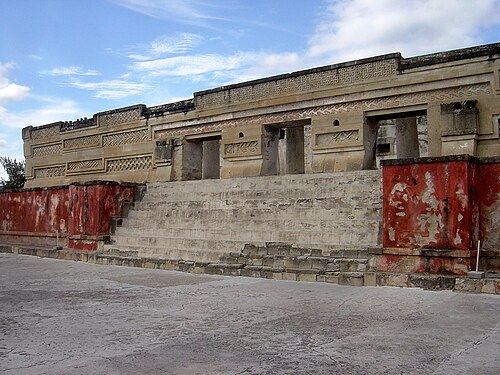
Landmark · Americas
Mitla
100 CE – still standing
Polity · Americas
Chorrera
Attested 1500 BCE – 100 BCETrade route · Americas
Mesoamerican Trade Network
1200 BCE – 1521 CEConflict · Americas
Teotihuacan Entrada into the Maya Lowlands
378 CE
Landmark · Americas
Huaca de la Luna
100 CE – 800 CE
Polity · Americas
Chavin
Attested 1000 BCE – 100 BCEConflict · Americas
Maya City-State Wars
400 BCE – 900 CE
Landmark · Americas
Pachacamac
200 CE – 1533 CEDated moments inside this span
Events the timeline places between 100 BCE and 400 CE.
And in the rest of the world
Records running through the same years, on the other side of the map.
Image credits 6 pictures from Wikimedia Commons
- Newark Earthworks Ericplayzbass · CC BY-SA 4.0
- Mitla Uploaded into English Wikipedia by en:User:Bobak Ha'Eri · CC BY 2.0
- Chorrera culture NASA · Public domain
- Huaca de la Luna Joel Takv · CC BY-SA 2.5
- ChavinMap QQuantum · CC BY-SA 4.0
- Pachacamac Apollo⠀ · CC BY 2.0


